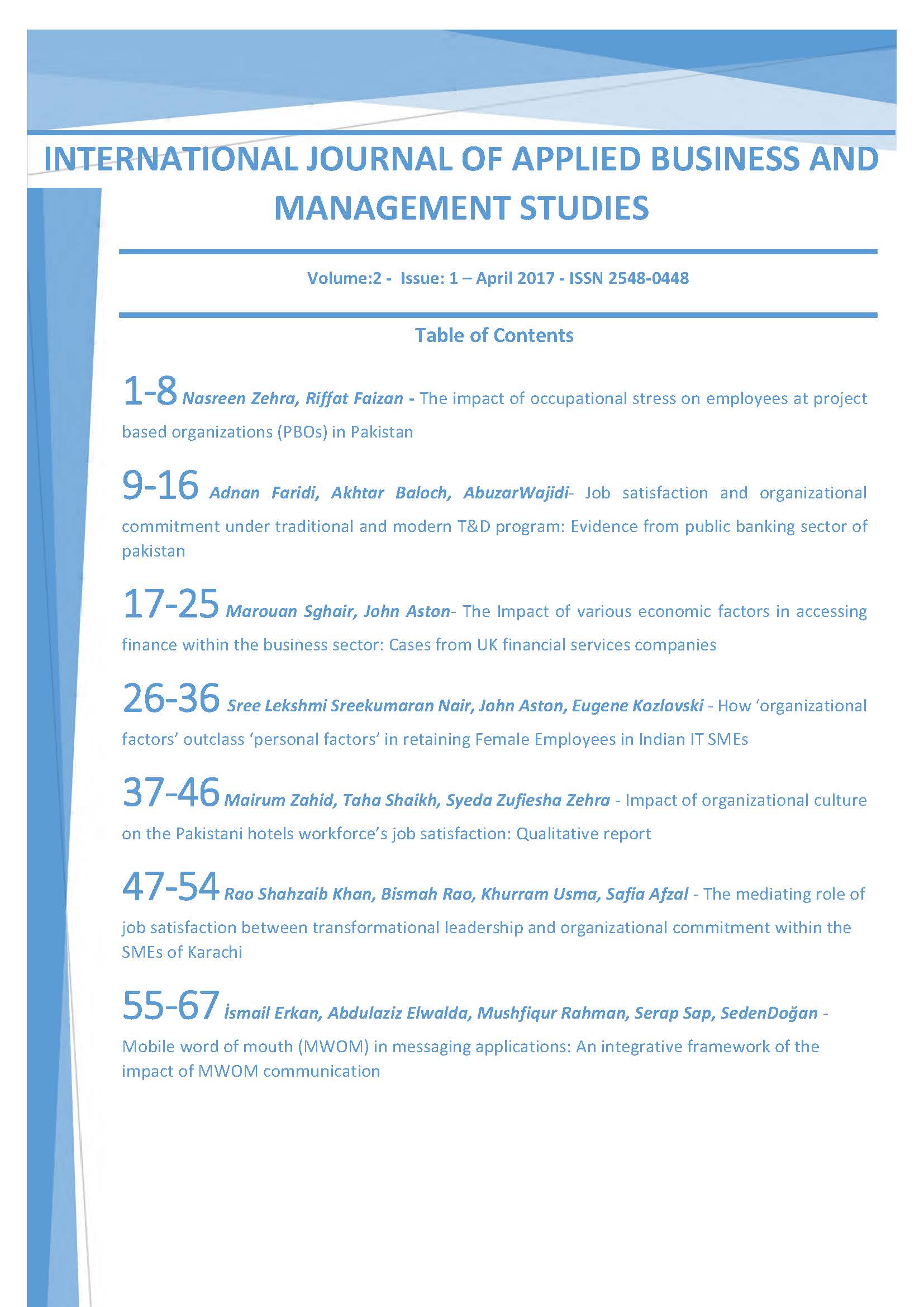
Mobile word of mouth (MWOM) in messaging applications: An integrative framework of the impact of MWOM communication
DOI:
https://doi.org/10.68099/ijabms.2017.257Keywords:
mobile word of mouth, MWOM, eWOM, messaging applications, mobile purchase intention, mobile purchase, viber, whatsappAbstract
Electronic word of mouth simply refers to brand-related conversations between consumers, and it has been considered as one of the most helpful information sources. The advent of mobile messaging applications (e.g. WhatsApp, Viber, Line) has freely and easily allowed customers to do brand-related conversations usingtheir smartphones, which is called mobile word of mouth (MWOM). The aim of this research is to develop an integrative framework of the impact of MWOM communication among consumers. To do this, we applied five well-establiesdrobust marketing and information systems theories: Theory of Reasoned Action, Theory of Planned Behaviour, Technology Acceptance Model, Information Adoption Model, and Information Acceptance Model. The framework developed in this study provides an important foundation for future MWOM research work.
References
Ajzen, I. (1991). The theory of planned behavior. Organizational Behavior and Human Decision Processes, 50(2), 179-211. http://doi.org/10.1016/0749-5978(91)90020-T DOI: https://doi.org/10.1016/0749-5978(91)90020-T
Alenezi, H., Tarhini, A., & Sharma, S. K. (2015). Development of quantitative model to investigate the strategic relationship between information quality and e-government benefits. Transforming Government: People, Process and Policy, 9(3), 324-351. http://doi.org/doi:10.1108/TG-08-2013-0026 DOI: https://doi.org/10.1108/TG-01-2015-0004
Arndt, J. (1967). Role of Product Related Conversations in the Diffusion of a new Product. Journal of Marketing Research, 4(3), 291-295. DOI: https://doi.org/10.1177/002224376700400308
Bai, B., Law, R., & Wen, I. (2008). The impact of website quality on customer satisfaction and purchase intentions: Evidence from Chinese online visitors. International Journal of Hospitality Management, 27(3), 391-402. Retrieved from http://www.sciencedirect.com/science/article/pii/S0278431907001028 DOI: https://doi.org/10.1016/j.ijhm.2007.10.008
Bailey, J. E., & Pearson, S. W. (1983). Development of a Tool for Measuring and Analyzing Computer User Satisfaction. Management Science, 29(5), 530-545. http://doi.org/10.1287/mnsc.29.5.530 DOI: https://doi.org/10.1287/mnsc.29.5.530
Barutçu, S. (2011). Mobil Viral Pazarlama. İnternet Uygulamalari ve Yönetimi Dergisi, 2(1), 5-14. Retrieved from http://www.journalagent.com/z4/vi.asp?pdir=iuyd&plng=tur&un=IUYD-87587&look4=
Bibby, P. A. (2008). Dispositional factors in the use of social networking sites: Findings and implications for social computing research. In International Conference on Intelligence and Security Informatics (pp. 392-400). Retrieved from http://link.springer.com/chapter/10.1007/978-3-540-69304-8_40 DOI: https://doi.org/10.1007/978-3-540-69304-8_40
Bickart, B., & Schindler, R. M. (2001). Internet forums as influential sources of consumer information. Journal of Interactive Marketing, 15(3), 31-40. http://doi.org/10.1002/dir.1014 DOI: https://doi.org/10.1002/dir.1014
Burtch, G., & Hong, Y. (2014). What happens when word of mouth goes mobile? In 35th International Conference on Information Systems. Auckland, New Zealand. Retrieved from https://papers.ssrn.com/sol3/papers.cfm?abstract_id=2519931
Chatterjee, P. (2001). Online Reviews: Do Consumers Use Them? Advances in Consumer Research, 28(1), 129-134. http://doi.org/10.2139/ssrn.900158
Cheung, C. M. K., Lee, M. K. O., & Rabjohn, N. (2008). The impact of electronic word-of-mouth: The adoption of online opinions in online customer communities. Internet Research, 18(3), 229-247. http://doi.org/10.1108/10662240810883290 DOI: https://doi.org/10.1108/10662240810883290
Cheung, C. M. K., & Thadani, D. R. (2012). The impact of electronic word-of-mouth communication: A literature analysis and integrative model. Decision Support Systems, 54(1), 461-470. http://doi.org/10.1016/j.dss.2012.06.008 DOI: https://doi.org/10.1016/j.dss.2012.06.008
Chu, S. C., & Choi, S. M. (2011). Electronic Word-of-Mouth in Social Networking Sites: A Cross-Cultural Study of the United States and China. Journal of Global Marketing, 24(3), 263-281. http://doi.org/10.1080/08911762.2011.592461 DOI: https://doi.org/10.1080/08911762.2011.592461
Chu, S. C., & Kim, Y. (2011). Determinants of consumer engagement in electronic word-of-mouth (eWOM) in social networking sites. International Journal of Advertising, 30(1), 47-75. http://doi.org/10.2501/IJA-30-1-047-075 DOI: https://doi.org/10.2501/IJA-30-1-047-075
Coyle, C. L., & Vaughn, H. (2008). Social networking: Communication revolution or evolution? Bell Labs Technical Journal, 13(2), 13-17. http://doi.org/10.1002/bltj.20298 DOI: https://doi.org/10.1002/bltj.20298
Davis, F. D. (1989). Perceived usefulness, perceived ease of use, and user acceptance of information technology. MIS Quarterly, 13(3), 319-340. http://doi.org/10.2307/249008 DOI: https://doi.org/10.2307/249008
Engel, J. E., Blackwell, R. D., & Kegerreis, R. J. (1969). How information is used to adopt an innovation. Journal of Advertising Research, 9(4), 3-8. http://doi.org/10.1002/asi DOI: https://doi.org/10.1080/00218499.1969.12520018
Erkan, I. (2014). "Vine": Do You Miss It? Electronic Word of Mouth on The Social Networking Site, Vine. International Journal of Business and Information, 9(4), 461-473. Retrieved from http://knowledgetaiwan.org/ojs/index.php/ijbi/article/viewFile/511/141
Erkan, I., & Evans, C. (2016a). Social media or shopping websites? The influence of eWOM on consumers' online purchase intentions. Journal of Marketing Communications, (May), 1-17. http://doi.org/10.1080/13527266.2016.1184706 DOI: https://doi.org/10.1080/13527266.2016.1184706
Erkan, I., & Evans, C. (2016b). The influence of eWOM in social media on consumers' purchase intentions: An extended approach to information adoption. Computers in Human Behavior, 61, 47-55. http://doi.org/10.1016/j.chb.2016.03.003 DOI: https://doi.org/10.1016/j.chb.2016.03.003
Gao, L., Waechter, K. A., & Bai, X. (2015). Understanding consumers' continuance intention towards mobile purchase: A theoretical framework and empirical study - A case of China. Computers in Human Behavior, 53, 249-262. http://doi.org/10.1016/j.chb.2015.07.014 DOI: https://doi.org/10.1016/j.chb.2015.07.014
Hajli, N. (2016). Ethical Environment in the Online Communities by Information Credibility: A Social Media Perspective. Journal of Business Ethics, pp. 1-12. http://doi.org/10.1007/s10551-016-3036-7 DOI: https://doi.org/10.1007/s10551-016-3036-7
Hennig-Thurau, T., Gwinner, K. P., Walsh, G., & Gremler, D. D. (2004). Electronic word-of-mouth via consumer-opinion platforms: What motivates consumers to articulate themselves on the Internet? Journal of Interactive Marketing, 18(1), 38-52. http://doi.org/10.1002/dir.10073 DOI: https://doi.org/10.1002/dir.10073
Hovland, C. I., Janis, I. L., & Kelley, H. H. (1953). Communication and Persuasion: Psychological Studies of Opinion Change. New Haven. CT. US. http://doi.org/10.2307/2087772 DOI: https://doi.org/10.2307/2087772
Klopper, H. (2002). Viral marketing: a powerful, but dangerous marketing tool. South African Journal of Information Management, 4(2). Retrieved from https://journals.co.za/content/info/4/2/AJA1560683X_312 DOI: https://doi.org/10.4102/sajim.v4i2.159
Ko, D.-G., Kirsch, L. J., & King, W. R. (2005). Antecedents of knowledge transfer from consultants to clients in enterprise system implementations. MIS Quarterly, 29(1), 59-85. http://doi.org/10.2307/25148668 DOI: https://doi.org/10.2307/25148668
Kumar, N., & Benbasat, I. (2006). The influence of recommendations and consumer reviews on evaluations of websites. Information Systems Research, 17(4), 425-439. http://doi.org/10.1287/isre.1060.0107 DOI: https://doi.org/10.1287/isre.1060.0107
Lee, E.-J., & Shin, S. Y. (2014). When do consumers buy online product reviews? Effects of review quality, product type, and reviewer's photo. Computers in Human Behavior, 31(1), 356-366. http://doi.org/10.1016/j.chb.2013.10.050 DOI: https://doi.org/10.1016/j.chb.2013.10.050
Lee, M., & Youn, S. (2009). Electronic word of mouth (eWOM): How eWOM platforms influence consumer product judgement. International Journal of Advertising, 28(3), 473-499. http://doi.org/10.2501/S0265048709200709 DOI: https://doi.org/10.2501/S0265048709200709
McGinnies, E., & Ward, C. D. (1980). Better Liked Than Right: Trustworthiness and Expertise as Factors in Credibility. Personality and Social Psychology Bulletin, 6(3), 467-472. http://doi.org/0803973233 DOI: https://doi.org/10.1177/014616728063023
Olshavsky, R. W. (1985). Perceived quality in consumer decision making: an integrated theoretical perspective. In J. Jacoby & J. C. Olson (Eds.), Perceived Quality: How Consumers View Stores and Merchandise (pp. 3-29). Lexington Books, Lexington, MA.
Palka, W., Pousttchi, K., & Wiedemann, D. G. (2009). Mobile word-of-mouth - A grounded theory of mobile viral marketing. Journal of Information Technology, 24(2), 172-185. http://doi.org/10.1057/jit.2008.37 DOI: https://doi.org/10.1057/jit.2008.37
Park, D.-H., Lee, J., & Han, I. (2007). The Effect of On-Line Consumer Reviews on Consumer Purchasing Intention: The Moderating Role of Involvement. International Journal of Electronic Commerce, 11(4), 125-148. http://doi.org/10.2753/JEC1086-4415110405 DOI: https://doi.org/10.2753/JEC1086-4415110405
Porter, C. E., & Donthu, N. (2006). Using the Technology Acceptance Model to Explain how Attitudes Determine Internet Usage: The Role of Perceived Access Barriers and Demographics. Journal of Business Research, 59(9), 999-1007. http://doi.org/10.1016/j.jbusres.2006.06.003 DOI: https://doi.org/10.1016/j.jbusres.2006.06.003
Qiu, Q. (2016). Credibility of Word-of-Mouth in Mobile Services: An Empirical Analysis. In e-Business Engineering (ICEBE), 13th IEEE International Conference on e-Business Engineering (pp. 202-207). Macau, China. Retrieved from http://ieeexplore.ieee.org/abstract/document/7809923/ DOI: https://doi.org/10.1109/ICEBE.2016.042
Rauniar, R., Rawski, G., Yang, J., & Johnson, B. (2014). Technology acceptance model (TAM) and social media usage: an empirical study on Facebook. Journal of Enterprise Information Management, 27(1), 6-30. http://doi.org/10.1108/JEIM-04-2012-0011 DOI: https://doi.org/10.1108/JEIM-04-2012-0011
Shen, X.-L., Wang, N., Sun, Y., & Xiang, L. (2013). Unleash the power of mobile word-of-mouth An empirical study of system and information characteristics in ubiquitous decision making. Online Information Review, 37(1), 42-60. http://doi.org/10.1108/14684521311311621 DOI: https://doi.org/10.1108/14684521311311621
Shintaro, O. (2008). Determinant Factors of Mobile-Based Word-of-Mouth Campaign Referral among Japanese Adolescents. Psychology & Marketing, 25(8), 714-731. http://doi.org/10.1002/mar.20235 DOI: https://doi.org/10.1002/mar.20235
Sundaram, D. S., Kaushik, M., & Webster, C. (1998). Word of Mouth Communications: A motivational Analysis. Advances in Consumer Research, 25, 527-532.
Sussman, S. W., & Siegal, W. S. (2003). Informational influence in organizations: An integrated approach to knowledge adoption. Information Systems Research, 14(1), 47-65. http://doi.org/10.1287/isre.14.1.47.14767 DOI: https://doi.org/10.1287/isre.14.1.47.14767
Tarhini, A., Hone, K., & Liu, X. (2013). Factors Affecting Students' Acceptance of e-Learning Environments in Developing Countries: A Structural Equation Modeling Approach. International Journal of Information and Education Technology, 3(1), 54-59. http://doi.org/10.7763/IJIET.2013.V3.233 DOI: https://doi.org/10.7763/IJIET.2013.V3.233
Trusov, M., Bucklin, R. E., & Pauwels, K. (2009). Effects of Word-of-Mouth Versus Traditional Marketing: Findings from an Internet Social Networking Site. Journal of Marketing, 73(5), 90-102. http://doi.org/10.1509/jmkg.73.5.90 DOI: https://doi.org/10.1509/jmkg.73.5.90
Wang, N., Shen, X.-L., & Sun, Y. (2013). Transition of electronic word-of-mouth services from web to mobile context: A trust transfer perspective. Decision Support Systems, 54(3), 1394-1403. http://doi.org/10.1016/j.dss.2012.12.015 DOI: https://doi.org/10.1016/j.dss.2012.12.015
Wiedemann, D. G. (2007). Exploring the Concept of Mobile Viral Marketing through Case Study Research. In Proceedings of the 2nd Conference on Mobility and Mobile Information Systems (pp. 49-60). Aachen, Germany. Retrieved from https://pdfs.semanticscholar.org/09aa/05a7b067751b854325f8f4876486a00a937e.pdf
Wolny, J., & Mueller, C. (2013). Analysis of fashion consumers' motives to engage in electronic word-of-mouth communication through social media platforms. Journal of Marketing Management, 29(5-6), 562-583. http://doi.org/10.1080/0267257X.2013.778324 DOI: https://doi.org/10.1080/0267257X.2013.778324
Wong, C. H., Tan, G. W. H., Ooi, K. B., & Lin, B. (2014). Mobile shopping: the next frontier of the shopping industry? An emerging market perspective. International Journal of Mobile Communications, 13(1), 92-112. http://doi.org/10.1504/IJMC.2015.065892 DOI: https://doi.org/10.1504/IJMC.2015.065892
Yang, H. C., & Zhou, L. (2011). Extending TPB and TAM to mobile viral marketing: An exploratory study on American young consumers' mobile viral marketing attitude, intent and behavior. Journal of Targeting, Measurement and Analysis for Marketing, 19(2), 85-98. Retrieved from http://link.springer.com/article/10.1057/jt.2011.11 DOI: https://doi.org/10.1057/jt.2011.11
Zhang, J. Q., Craciun, G., & Shin, D. (2010). When does electronic word-of-mouth matter? A study of consumer product reviews. Journal of Business Research, 63(12), 1336-1341. http://doi.org/10.1016/j.jbusres.2009.12.011 DOI: https://doi.org/10.1016/j.jbusres.2009.12.011
Zhou, T. (2013). An empirical examination of the determinants of mobile purchase. Personal and Ubiquitous Computing, 17(1), 187-195. http://doi.org/10.1007/s00779-011-0485-y DOI: https://doi.org/10.1007/s00779-011-0485-y
Downloads
Published
Issue
Section
License
Copyright (c) 2026 İsmail Erkan, Abdulaziz Elwalda, Mushfiqur Rahman, Serap Sap, Seden Doğan (Author)

This work is licensed under a Creative Commons Attribution-NonCommercial 4.0 International License.