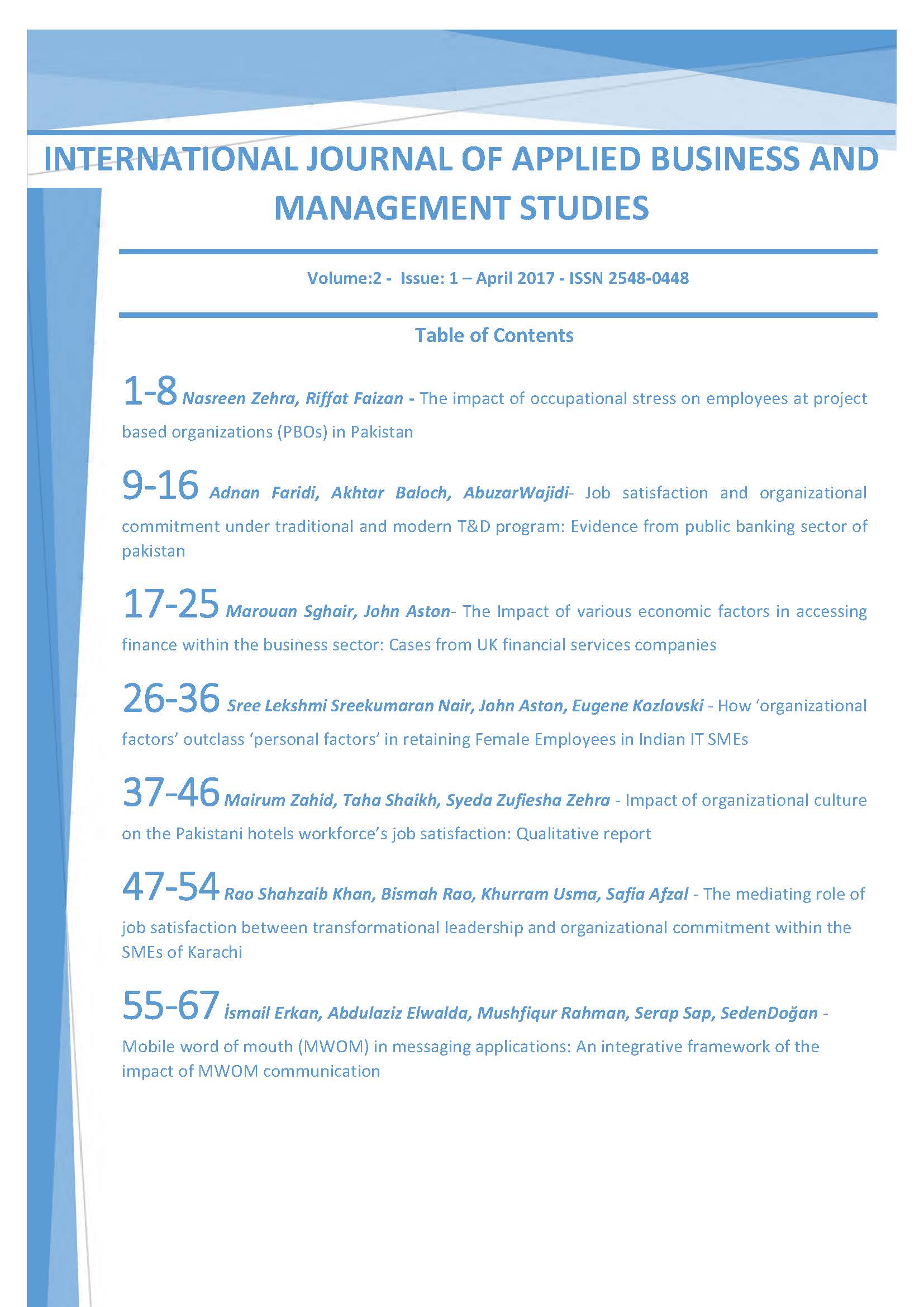
The Impact ofOccupational Stress on Employees at Project BasedOrganizations (PBOs) in Pakistan
DOI:
https://doi.org/10.68099/ijabms.2017.251Keywords:
Occupational stress, pay scale, personal stressors, work-life balanceAbstract
This paper discusses the stress management impacts on the employee performances at workplace. Additionally, research evaluates the stress control's role in increasing employee motivation and overall satisfaction in project based organizations. Survey questionnaire and open-ended interviews are primary instruments used in this study. Total 112 employees participated in survey questionnaire while total 26 managers were interviewed. Findings revealed that unrealistic demands generate stress at workplace. Interestingly, we found traditional assumption of pay scale creating stress is opposed as 57% respondents have content with the pay scale thus pay scale is not the fundamental factor for generating stress. Furthermore, stress exists and operates in both micro and macro environment having equally significant impact on individuals. Their respective performance hinder due to decline in the working efficiency and quality work. Interestingly, we found that work-life balance is not effective in stress reduction but act as additional stressor for employees under chronic stress.
References
Caroll, D. Α. (2011). Stress- How to Deal With It. Available at: http://ezinearticles.com/?Stress---How-to-Deal-With-It&id=2732336.
Cicei, C. C. (2012). Occupational stress and organizational commitment in Romanian public organizations. Procedia - Social and Behavioral Sciences, 33, 1077-1081. DOI: https://doi.org/10.1016/j.sbspro.2012.01.288
Cooper, C.L., & Dewe, P. (2008). Well being, absenteeism, presenteeism: costs and challenges. Occupational medicines, 58(8), 225. DOI: https://doi.org/10.1093/occmed/kqn124
Cooper, C. L.,& Marshall, J. (1976). occupational source of stress: A review of the literature relating to the coronary heart diseases and mental ill health. Journal of Occupational Psychology, 49 (1), 11-28. DOI: https://doi.org/10.1111/j.2044-8325.1976.tb00325.x
Deery, M. (2008). Talent management, work-life balance and retention strategies, International Journal of Contemporary Hospitality Management, 20(7),792-806. DOI: https://doi.org/10.1108/09596110810897619
Faizan, R., & Zehra, N. (2016). Quality Work-Life as predictor to Organizational Commitment under contrasting Leadership Styles: I.T Responses from Pakistan's private software houses. Global Journal of Management and Administration, 16(6), 9-23.
Haque, A. U., & Aston, J. (2016). A Relationship between Occupational Stress and Organizational Commitment of I.T Sector's Employees in Contrasting Economies. Polish Journal of Management Studies, 14 (1), 95-105. DOI: https://doi.org/10.17512/pjms.2016.14.1.09
Haque, A. U., Aston, J., & Kozlovski, E. (2016). Do causes and consequences of stress affect genders differently at operational level? Comparison of the IT sectors in the UK and Pakistan. International Journal of Applied Business, 1 (1), 1-7.
Haque, A.U., & Yamoah, F. (2014). Gender Employment Longevity: I.T Staff Response to Organizational Support in Pakistan, International Journal of Academic Research in Business and Social Sciences, 4 (12), 324-347. DOI: https://doi.org/10.6007/IJARBSS/v4-i12/1367
John, N., & Menzel, P. J. (1999). "if you can't stand the heat "kitchen violence and culinary Arts, Hospitality Management, 18, 99-109. DOI: https://doi.org/10.1016/S0278-4319(99)00013-4
Karasek, R., & Theorell, T. (1990). Healthy Work: Stress, Productivity, and the Reconstruction of Working Life, Basic Books, NY: USA.
Kumasey, S.A., Delle, E., & Ofei, B.S. (2014). Occupational Stress and Organizational Commitment: Does Sex and Managerial Status Matter? International Journal of Business and Social Research (IJBSR), 4, 173-182.
Leith, P. (2002), "Cooks gives celebrity chefs a roasting", The Guardian, 11 October. [Google Scholar]
Liew, C. (2014). How to survive in a Fast-Paced Office Environment. SFU. Available at: http://www.sfu.ca/olc/blog/co-op/how-survive-fast-paced-office-environment.
Lieberman, S. (2011). Stress Management, Stress Solutions During Stressful times need executive stress solutions, Hospitality Executive under stress Available at: http://www.ideamarketers.com/?articleid=747596.
Maslach, C. (1993). "Burnout: a multidimensional perspective", in Schaufeli, W.B., Maslach, C. and Marek, T. (Eds), Professional Burnout: Recent Development in Theory and Research, Taylor and Francis, Washington, DC, pp. 20-31. [Google Scholar]
Ross, G. (1997). "Career stress responses among hospitality employees", Annals of Tourism Research, 24(1), 45-51. DOI: https://doi.org/10.1016/S0160-7383(96)00032-1
Rowley, G.,& Purcell, K. (2001). As cooks go, she went': is labour churn inevitable?, International Journal of Hospitality Management, 20, 163-185. DOI: https://doi.org/10.1016/S0278-4319(00)00050-5
Sekaran, U., & Bougie, R. (2012). Research methods for business: A skill building approach. 6th edition. West Sussex, UK: John Wiley & Sons Ltd.
Shaw, E. (1998). A guide to the qualitative research process: evidence from a small firm study, Qualitative Market Research: An International Journal, 2(2), 59-70. DOI: https://doi.org/10.1108/13522759910269973
Smith, M., & Carroll, M. (2006). Working Conditions in the HORECA Sector: Spanish Report, European Foundation for the Improvement of Working and Living Conditions, Dublin. [Google Scholar]
Wickramasinghe, V., & Liyanage, S. (2013). Effects of high performance work practices on job performance in project-based organizations. Project Management Journal, 44(3), 64-77. DOI: https://doi.org/10.1002/pmj.21342
Worrall, L., & Cooper, C.L. (2007). Managers Work life balance and health.The case of UK managers, European Journal of International management, 1(1-2), 129-145. DOI: https://doi.org/10.1504/EJIM.2007.012921
Zehra, S. Z., Zehra, B., Nisa, F.U., Ali, S. Z., Zehra, S. H., & Ather, M. (2017). Measuring Organizational Commitment and Occupational Stress of Pakistani Doctors: Comparing Lahore and Karachi Public Hospitals in Gender Perspective. International Journal of Academic Research in Business and Social Sciences, 7 (2), 247-255.
Zhang, H., & Tan, J. (2012). Discuss employee wellbeing in project based organizations from a human resource management perspective. ISRN LIU-IEI-FIL-A--12/01238--SE. Available at: http://www.diva-portal.org/smash/get/diva2:556592/fulltext01.pdf
Downloads
Published
Issue
Section
License
Copyright (c) 2026 Nasreen Zehra, Riffat Faizan (Author)

This work is licensed under a Creative Commons Attribution-NonCommercial 4.0 International License.